That single instinct is the most expensive mistake brands make in this channel. Sponsorship pricing runs on a specific formula, and once you understand it, you can walk into any negotiation with a defensible number instead of a hopeful guess.
Here's how the money actually works.
The formula every deal is built on
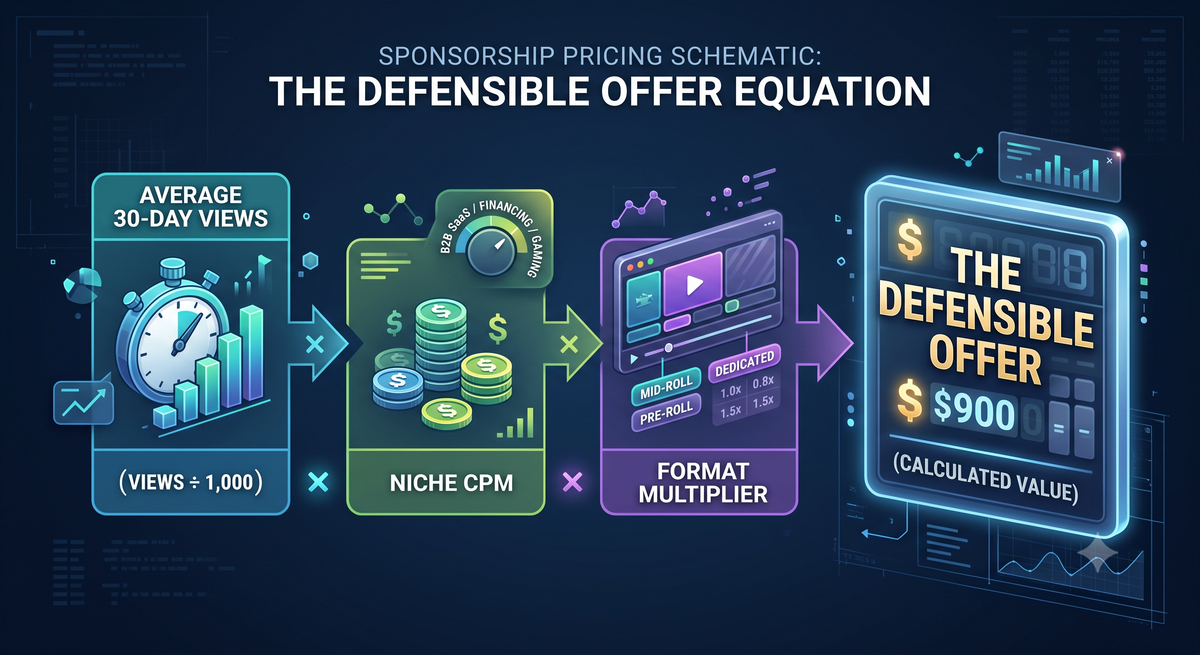
There is no official rate card for YouTube sponsorships. Pricing is deliberately opaque, which is precisely why brands overpay. But underneath that opacity, the market has converged on one equation:
(average views ÷ 1,000) × niche CPM × format multiplierThat's it. Multiple creator-side pricing tools: SponsorKit.Pro, YTMoneyCalculator, and OutlierKit among them all build their guidance on this exact structure.
The unit that matters is CPM: cost per 1,000 views, paid directly to the creator. This is a different animal from the AdSense CPM you might have seen quoted. When a brand sponsors a creator, it pays that creator directly rather than bidding through YouTube's ad auction, which is why sponsorship CPMs typically run 5 to 20 times higher than AdSense CPMs in the same niche (per YTMoneyCalculator).
Why subscriber count is a trap
SponsorRadar puts it bluntly: a channel with 500,000 subscribers averaging 20,000 views per video is worth far less than a 100,000-subscriber channel averaging 80,000 views. Subscribers are a vanity number. What you're buying is attention that shows up when a video publishes.
The practical rule: price on average views over the last 30 to 90 days not lifetime totals, not a creator's single best-performing viral hit. Any brand doing proper due diligence should ask to see recent analytics and calculate from there. OutlierKit, SponsorKit.Pro, and YTMoneyCalculator all point to this recent-average window as the honest baseline.
What CPMs actually look like in my niche in 2026
Here's where the money gets specific. OutlierKit's 2026 niche CPM table gives a clean integration baseline:
- B2B SaaS / developer tools: $40–$80
- Personal finance: $30–$60
- AI / productivity: $28–$55
- Tech reviews: $25–$45
- Education: $20–$40
- Beauty: $18–$35
- Cooking: $18–$30
- Gaming: $15–$30
- Lifestyle: $15–$25
Now, the ranges disagree across sources, and it's worth understanding why. SponsorRadar pegs gaming at $10–$25, tech at $30–$60, and finance at $40–$80. SponsorKit.Pro goes wider, putting gaming as low as $3–$12 but finance, tech, and B2B SaaS as high as $50–$200. YTMoneyCalculator quotes an overall spread of $3 to $80+.
The divergence isn't sloppiness, it's a real feature of an unregulated market. These are self-reported benchmarks from creator-tooling companies, not audited figures. Treat them as ranges, not gospel.
But the pattern is consistent, no matter whose data you use: finance, B2B SaaS, and tech sit at the top; gaming, lifestyle, and music sit at the bottom. The 40x-plus spread is driven by one thing, audience purchasing intent. Brands pay for what an audience is likely to buy, not for raw reach. A finance channel's viewers are researching purchases with real dollar values attached. That's what justifies the premium.
Format multipliers: the deliverable changes the price
The base CPM assumes a standard integration. Change the deliverable, and you apply a multiplier:
- Standard 60–90 second mid-roll integration: 1.0× (the baseline)
- Short pre-roll shoutout: roughly 0.7×–0.9× (OutlierKit cites a 30–50% discount for short integrations)
- Dedicated video (the whole video is about your product): here the sources split hard OutlierKit and SponsorKit.Pro say 1.3×–1.5×, YTMoneyCalculator uses about 1.75×, and Veefly argues for 2.5×–4.0× when the brand wants a fully produced dedicated asset.
That dedicated-video premium is the least standardized number in the entire market, and it's worth flagging why. “Dedicated” can mean anything from a creator spending a few extra minutes on-camera to a full production job with scripting, B-roll, and multiple shoot days. The 1.3× figure and the 4× figure are pricing two genuinely different amounts of labour. Get specific about scope before you accept either.
A worked example (from YTMoneyCalculator): a tech channel averaging 30,000 views at a $30 CPM comes to (30,000 ÷ 1,000) × $30 = $900 for a mid-roll integration. Apply a 1.75× dedicated-video multiplier, and you're at $1,575.
The premiums brands forget to budget for
The base fee is rarely the entire invoice. Expect these line items:
- Usage and Paid-media rights: If you want to cut the creator's video into your own paid ads, add 25%–100% of the base fee, depending on the usage window. At that point, the creator is effectively acting as your ad agency (per Veefly).
- Exclusivity: If you want the creator to not feature competitors for a period, that's a separate premium.
- Your management time and tooling to actually run the campaign a cost SponsorRadar flags that brands routinely overlook.
Veefly frames the true total as: Base Integration Fee + Production Labor + Usage Rights Premium + Exclusivity Protection.
Typical deal sizes by creator tier
If you want quick flat-dollar orientation before running the formula, YTMoneyCalculator's per-deal ranges are useful:
- Nano creators: $100–$500
- Micro creators: $500–$5,000
- Large channels: $2,000–$50,000
Veefly adds a mid-tier data point: a growing creator (10K–50K subs) with a steady ~15,000 views in a mid-value niche like productivity commands a minimum of $1,200–$2,500 per integration.
There's also a rough per-subscriber shorthand from OutlierKit lifestyle at $0.01–$0.03/sub, finance and tech at $0.05–$0.10/sub, B2B SaaS at $0.10–$0.20+/sub but treat this as a sanity check only. Real pricing is view-based; this is just a back-of-envelope gut check.
Shorts are a separate market
Don't assume Shorts are just discounted long-form. Sponsored Shorts typically pay $5–$15 CPM, roughly half the long-form rate because shorts views convert at a lower rate (per OutlierKit). Dedicated Shorts pricing guides now exist as their own 2026 category, which tells you the market treats Shorts sponsorships as a distinct product rather than a markdown on video integrations.
What to expect at the negotiating table
Both sides come in expecting a dance. YT Money Calculator notes that brands routinely open 30–40% below their actual budget as standard practice, and creators are coached to expect exactly that and counter. Veefly, meanwhile, tells creators to open about 30% above their baseline minimum. Translation: the real deal usually lands somewhere in the middle, so plan your opening and your ceiling accordingly.
The genuine value of the view-based formula is that it gives both parties a math-backed anchor what SponsorKit.Pro calls it a “defensible floor.” Example: a general-niche creator with 25,000 average views at a $30 CPM on a standard integration produces a $750 floor. When negotiations get emotional, the formula is what pulls the conversation back to something objective.
The bottom line for brand-side buyers
Strip away the noise, and your playbook is simple:
- Ignore subscriber count. Ask for the last 30 to 90day days average views.
- Apply a niche CPM; expect $15–$30 for lifestyle and gaming, $40–$80+ for finance, tech, and B2B SaaS.
- Multiply by format 1.0× for a standard integration, less for a shoutout, more for a dedicated video (and pin down what “dedicated” actually means).
- Add premiums for usage rights and exclusivity if you need them.
- Open below budget, expect a counter, and let the formula anchor the middle.
Remember that every figure above comes from creator-side tooling and monetization sources useful market ranges, but self-reported rather than audited. Use them to build your model, verify against the specific creator's real analytics, and you'll pay for attention that actually converts instead of subscriber counts that don't.